
RD vs FD: What Is the Difference?
Compare recurring deposits and fixed deposits, including how deposits, interest and maturity values work.
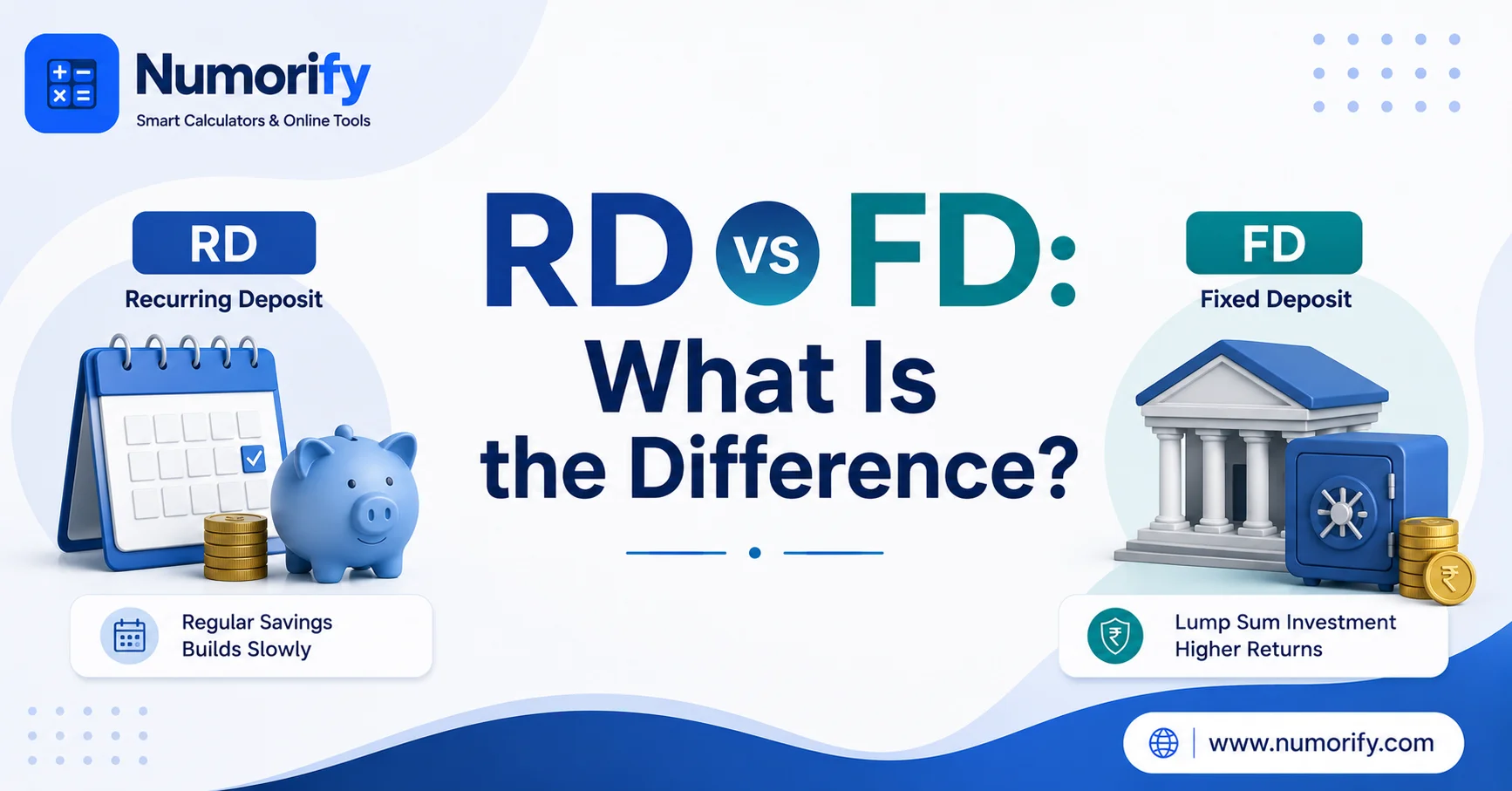
Recurring Deposit (RD) and Fixed Deposit (FD) are both deposit products designed to help you earn interest on money kept with a bank or financial institution. The main difference is how you put money into the deposit: an RD generally involves regular deposits, while an FD usually involves investing a lump sum for a chosen period.
This guide explains RD vs FD, how recurring and fixed deposits work, how interest and maturity values are determined, and which type may suit different saving habits.
Quick comparison
An FD is generally suited to investing a lump sum, while an RD is generally suited to making regular deposits over time. The actual interest rate, compounding frequency, minimum deposit, tenure and premature-withdrawal rules depend on the institution and product.
What Is a Fixed Deposit (FD)?
A Fixed Deposit is a deposit in which you place a lump sum for a selected tenure at a stated interest rate. The money remains invested for the agreed period, and the deposit earns interest according to the product's terms.
At maturity, you receive the principal together with the interest payable under the FD's terms. Depending on the product, interest may be paid periodically or accumulated and paid with the maturity amount.
What Is a Recurring Deposit (RD)?
A Recurring Deposit allows you to deposit a fixed amount at regular intervals, commonly every month, for a selected tenure. Each instalment contributes to the deposit, and interest is earned according to the institution's RD rules.
An RD can be useful when you want to build savings gradually rather than invest a large amount at one time.
RD vs FD: Key Differences
| Feature | RD | FD |
|---|---|---|
| Deposit method | Regular instalments | Lump-sum deposit |
| Saving pattern | Gradual savings | One-time investment |
| Interest | Based on RD terms and instalment timing | Based on FD terms and deposit amount |
| Best suited for | Regular savers | People with a lump sum |
| Maturity value | Total instalments plus applicable interest | Principal plus applicable interest |
How Does an FD Maturity Value Work?
For a fixed deposit, the maturity value depends on the principal, interest rate, tenure and compounding or payout method specified by the institution.
For an illustration using annual compounding, a simplified future-value calculation can be written as:
A = P × (1 + R/100)T
Illustrative annual-compounding formula; actual FD calculation may differ by product.
Here, P is the principal, R is the annual interest rate and T is the tenure in years.
How Does an RD Maturity Value Work?
In an RD, you make a series of deposits rather than investing the full amount on the first day. Because each instalment is deposited at a different time, the interest calculation is different from a lump-sum FD.
The maturity value depends on the regular instalment, interest rate, tenure, compounding method and the institution's RD calculation rules. For an exact result, use the institution's stated method or an RD calculator.
Example of RD vs FD
Suppose you have ₹60,000 available for saving. With an FD, you could place the ₹60,000 as a lump sum. With an RD, you could instead spread the saving across regular instalments, subject to the product's minimum deposit and tenure requirements.
Simple illustration
FD
₹60,000 deposited as a lump sum.
RD
Regular instalments add up to the planned savings amount.
The two products should not be compared only by multiplying the RD instalment by the number of months. The timing of each RD instalment affects how long each instalment earns interest.
RD or FD: Which Is Better?
Neither option is automatically better for every saver. The more suitable choice depends on whether you have a lump sum available and whether you prefer one-time or regular deposits.
- Choose an FD when you have a lump sum and want to lock it in for a chosen tenure.
- Choose an RD when you want to save a fixed amount regularly from your income.
- Compare the product terms before deciding, including interest rate, tenure, payout, premature closure and applicable conditions.
RD vs FD: What Should You Check?
- Interest rate offered for your chosen tenure
- Minimum deposit or instalment amount
- Compounding or interest payout frequency
- Maturity date and maturity value
- Rules for premature withdrawal or closure
- Any applicable charges, penalties or taxes
Calculate RD and FD Returns
You can estimate the maturity value of your savings using the Recurring Deposit Calculator for RD investments or the Fixed Deposit Calculator for lump-sum FD investments.