
Ohm's Law Explained
Learn the relationship between voltage, current and resistance with simple examples.
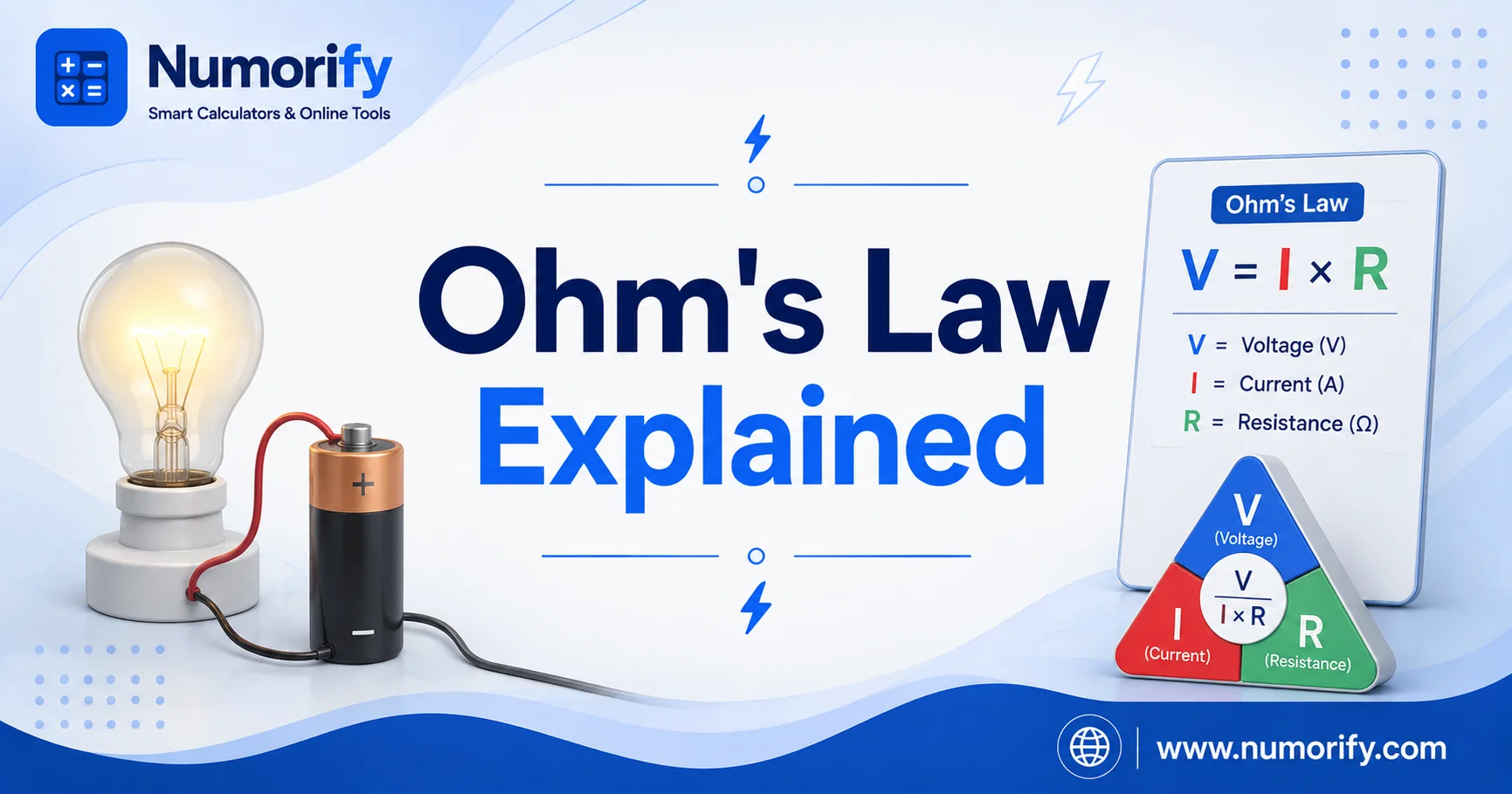
Ohm's Law is one of the fundamental relationships used to understand electrical circuits. It connects three important quantities: voltage, current and resistance.
Understanding Ohm's Law makes it easier to calculate an unknown electrical quantity when the other two are known. It is useful in basic circuit analysis, electronics and electrical engineering.
Quick answer
Ohm's Law states that current is equal to voltage divided by resistance. The relationship is commonly written as V = I × R.
V = I × R
Voltage = Current × Resistance
What Is Ohm's Law?
Ohm's Law describes the relationship between the voltage applied across a component, the current flowing through it and its electrical resistance. For an ohmic conductor under suitable conditions, the current is proportional to the applied voltage when resistance remains constant.
The three quantities are represented by:
- V = Voltage, measured in volts (V)
- I = Current, measured in amperes or amps (A)
- R = Resistance, measured in ohms (Ω)
Ohm's Law Formula
The standard form of Ohm's Law is:
V = I × R
The formula can be rearranged to find any one of the three quantities:
Current
I = V ÷ R
Voltage
V = I × R
Resistance
R = V ÷ I
Understanding Voltage, Current and Resistance
Voltage
Voltage is the electrical potential difference between two points. It provides the potential that drives current through a circuit.
Current
Current describes the rate at which electric charge flows through a circuit. It is measured in amperes (A).
Resistance
Resistance describes how strongly a component or material opposes the flow of electric current. It is measured in ohms (Ω).
Ohm's Law Example: Finding Current
Suppose a circuit has a voltage of 12 V and a resistance of 4 Ω. To find the current, use I = V ÷ R.
Calculation
I = 12 ÷ 4 = 3 A
Therefore, the current is 3 amperes.
Ohm's Law Example: Finding Voltage
If a circuit carries 2 A of current through a 10 Ω resistor, the voltage is:
V = 2 × 10 = 20 V
So the voltage across the resistor is 20 volts.
Ohm's Law Example: Finding Resistance
If a component has 24 V across it and 3 A of current flows through it, its resistance is:
R = 24 ÷ 3 = 8 Ω
Therefore, the resistance is 8 ohms.
Ohm's Law Triangle
A common memory aid is the Ohm's Law triangle. It places voltage at the top and current and resistance underneath. Covering the quantity you want to find helps you remember whether to multiply or divide.
V = I × R
Ohm's Law and Electrical Power
Ohm's Law can also be combined with the electrical power formula P = V × I. This gives useful forms for calculating power in resistive circuits:
P = V × I
P = I²R
P = V²/R
These relationships are useful when analysing how voltage, current, resistance and power are connected in an electrical circuit.
When Does Ohm's Law Apply?
Ohm's Law is most directly applicable to components or materials that behave approximately ohmically over the operating range being considered. Some components are non-ohmic, meaning their resistance can change with voltage, current, temperature or other conditions.
For practical circuit analysis, always consider the characteristics of the particular component rather than assuming that resistance is constant in every situation.