
How to Calculate an Average
Learn the basic average formula and how to calculate the mean of a set of numbers.
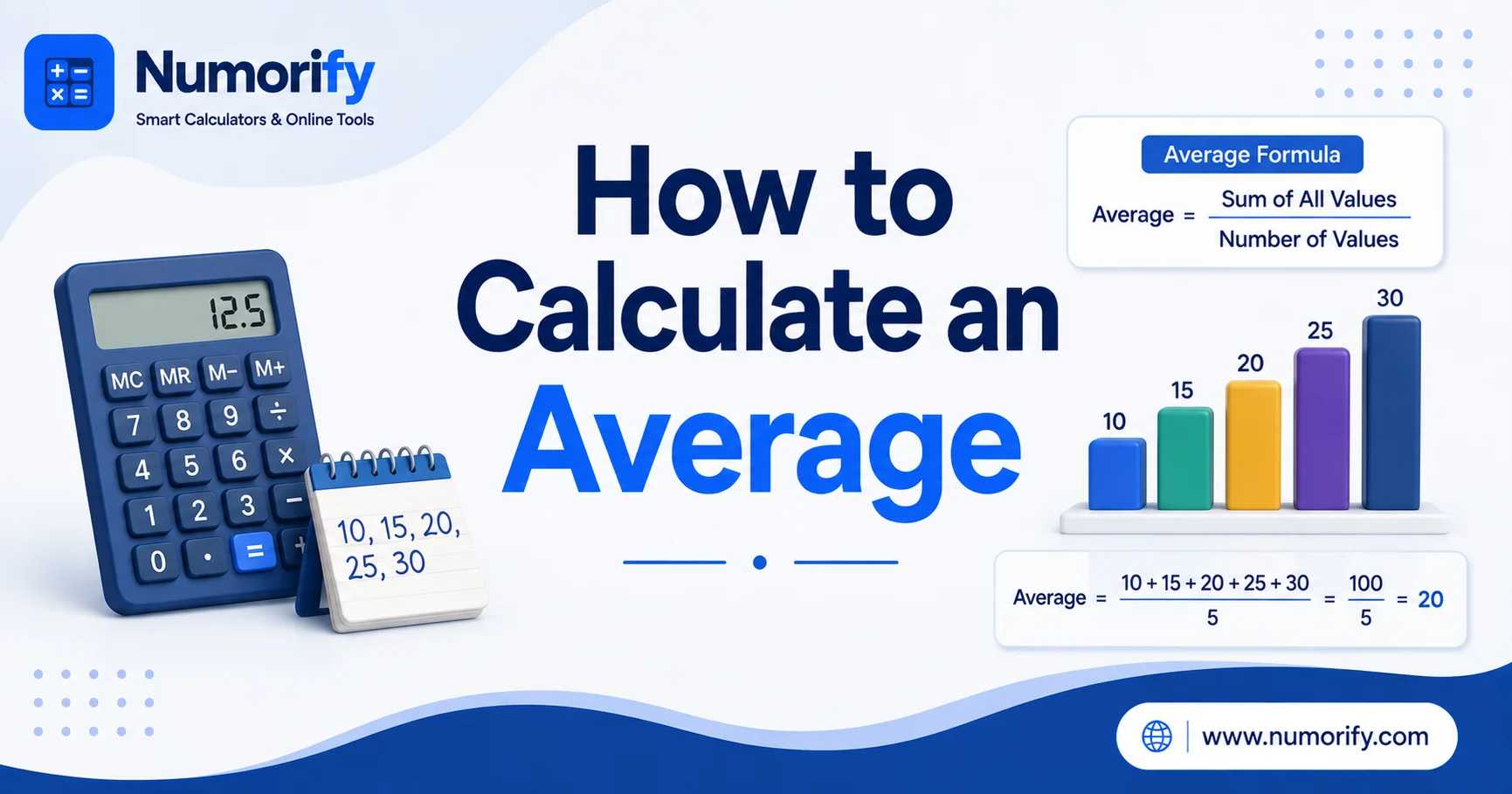
An average is a single value used to represent a set of numbers. In everyday mathematics, the word average commonly refers to the arithmetic mean. It is calculated by adding all the values and dividing the total by the number of values.
Knowing how to calculate an average is useful when comparing test scores, prices, measurements, ratings, expenses and many other sets of numerical data.
Quick answer
To calculate an average, add all the numbers together and divide the sum by the number of numbers.
Average = Sum of values ÷ Number of values
What Is an Average?
The arithmetic average, also called the mean, is a measure of the central value of a group of numbers. It distributes the total equally across the number of values.
For example, if three numbers have a total of 30, their average is 10 because 30 is shared equally among three values.
Average Formula
The basic average formula is:
Average = Sum of all values ÷ Number of values
In mathematical notation, the arithmetic mean can also be written as:
Mean = (x₁ + x₂ + x₃ + ... + xₙ) ÷ n
Here, the x values are the numbers in the set and n is the number of values.
How to Calculate an Average Step by Step
- Write down all the numbers in the set.
- Add all the numbers to find their sum.
- Count how many numbers are in the set.
- Divide the sum by the number of values.
- The result is the arithmetic average.
Example: Average of 10, 20, 30, 40 and 50
First, add the five numbers:
Sum = 10 + 20 + 30 + 40 + 50
Sum = 150
There are 5 values, so:
Average = 150 ÷ 5
Average = 30
Therefore, the average is 30.
How to Calculate the Average of a Set of Numbers
The same method works for any set of numerical values. For example, consider the numbers 12, 18, 25, 30 and 35.
Sum = 12 + 18 + 25 + 30 + 35 = 120
Number of values = 5
Average = 120 ÷ 5 = 24
So, the average of the five numbers is 24.
How to Calculate Average Marks
To calculate average marks, add the marks obtained in all the subjects or tests and divide by the number of subjects or tests.
Example: Five test scores
Suppose a student scores 70, 75, 80, 85 and 90 in five tests.
Total = 70 + 75 + 80 + 85 + 90 = 400
Average marks = 400 ÷ 5
= 80
The student's average score is 80 marks.
How to Calculate Average Percentage
If each percentage value represents an equally weighted observation, you can calculate the arithmetic mean by adding the percentages and dividing by the number of percentages.
Example: 60%, 70% and 80%
Average percentage = (60 + 70 + 80) ÷ 3
= 210 ÷ 3
= 70%
However, if percentages come from groups with different totals or different weights, a simple average may not be appropriate. In those cases, use a weighted calculation based on the underlying totals or weights.
What Happens When the Average Is Not a Whole Number?
An average does not have to be a whole number. It can be a decimal or fraction.
For example, the average of 10, 11 and 12 is:
Average = (10 + 11 + 12) ÷ 3
= 33 ÷ 3
= 11
But the average of 10, 11 and 13 is:
Average = 34 ÷ 3
≈ 11.33
The result can be rounded to a suitable number of decimal places when necessary.
Average, Mean, Median and Mode
The arithmetic mean is only one way to describe the center of a data set. Median is the middle value after arranging the numbers in order, while mode is the value that occurs most frequently.
| Measure | Meaning |
|---|---|
| Mean | Sum of values divided by the number of values |
| Median | Middle value when the data is ordered |
| Mode | Most frequently occurring value |
How to Calculate an Average Quickly
For a small set of numbers, you can calculate the average manually. For larger data sets, a spreadsheet or calculator can reduce arithmetic errors.
The key is always the same: find the total of the values and divide by how many values were included.